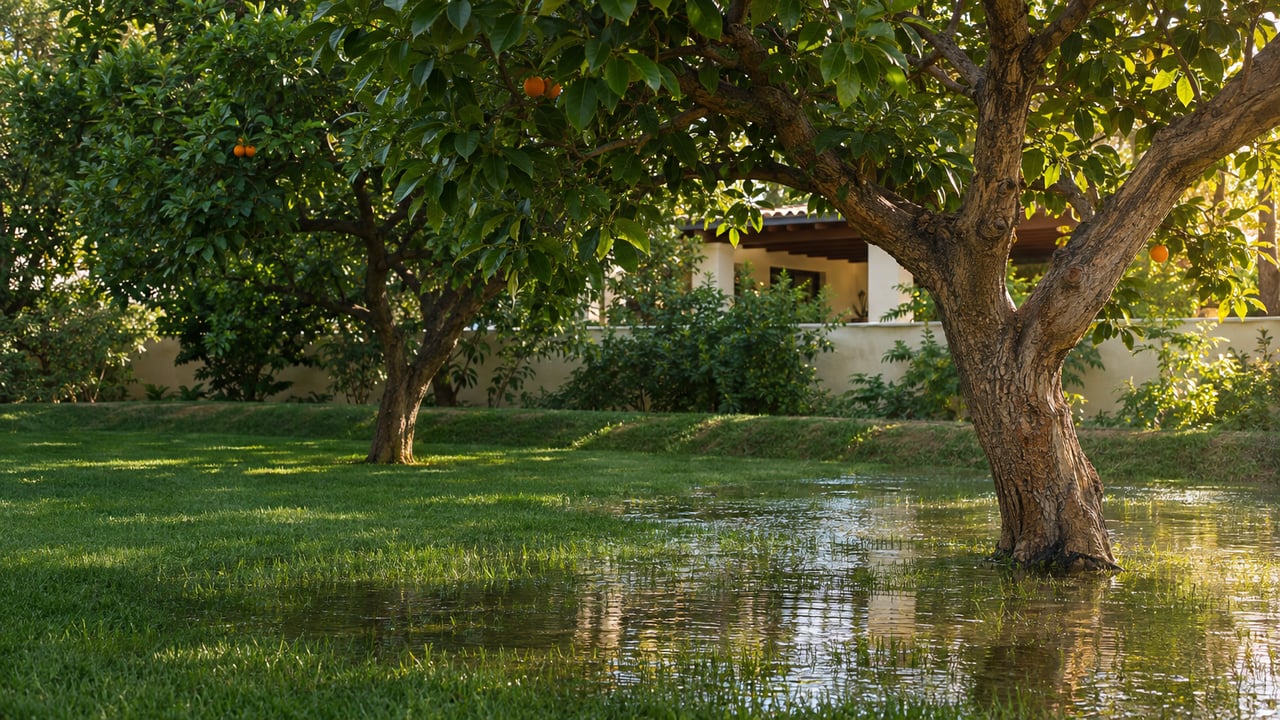
On the evening of Nov. 10, 2026, Arcadia Water Company's schedule had water running in one window from 7:00 p.m. until 8:30 the next morning. Earlier that day, deliveries to houses on 45th Place and 46th Street ran between one and two hours each. That schedule is the plumbing behind the citrus and old shade trees that make Arcadia look like Arcadia. In this neighborhood, flood irrigation comes from two separate systems with different sources, different calendars and different bills. A buyer comparing two Arcadia homes with similar lots can be comparing two very different ways of keeping that canopy alive.
A water company older than most of the houses
Arcadia began as an irrigation project. In 1915, L.E. Froman recorded Citrus Homes, a tract of 25 north-south lots between Camelback Road, Lafayette Boulevard, 56th Street and the Arizona Canal. The original Arcadia plat followed in December 1919. It was cut into five- and ten-acre parcels that the developers, including Seymour Jordan, Robert Grace and Charles Keafer, hoped buyers would plant as citrus orchards.
The higher ground needed its own water. According to Arcadia News, Jordan and Grace formed the Arcadia Water Company in October 1919 with Mike Krieg and Keafer. The first home they built in Arcadia went to their irrigation foreman, and it is now part of the Shemer Art Center. The company was set up to serve about 1,500 acres north of the Arizona Canal and south of Camelback Road, with one share of stock per acre. City of Phoenix survey records show later subdivisions such as Arcadia Estates in 1926 and Alta Hacienda in 1929.
The company never closed. It is still an Arizona nonprofit that delivers irrigation water only to its members, and an elected 11-person board runs it. When it turned 100, Arcadia News reported that it served about 800 homes. Five deep wells pump groundwater into a reservoir of about 375,000 gallons under the company's parking lot. From there, main lines run along Camelback Road to 64th Street, and a lower line turns south on 64th Street to Exeter and runs west to 44th Street. In the same story, then-manager Matt Rizzo said, "Because of this company, Arcadia is able to continue to be a greenbelt."
The second system runs on the canal
The rest of the area's flood irrigation comes from the Salt River Project. Phoenix New Times reported in 2015 that SRP water is used heavily for flood irrigation in the Arcadia area, including on residential properties. SRP water comes through the canal network, so it follows the canal's calendar.
The canal sets the timing. Under SRP's residential schedule, deliveries come about every 14 days from April through September and about every 28 days from October through March. SRP also closes canals each winter for maintenance, and its owner's manual says residential irrigation water is not typically delivered while a canal is dry. SRP lists the Arizona Canal as a north-side canal. The current SRP dry-up schedule puts the Northside dry-up at Jan. 3 to Feb. 7, 2027. The Southside dry-up, Nov. 20 to Dec. 24, 2026, is on the other side of the Salt River.
For an SRP-served Arcadia lot, the winter's longest gap in deliveries comes in January. A buyer closing in December who plans to replant a citrus bed or put in a new shade tree is working against that window. SRP's own fall newsletter says fall is a good time to plant shade trees such as mesquite, desert willow and palo verde because they benefit from deep watering. Arcadia Water Company customers draw from the company's own wells, so their schedule comes from the company and not from the canal.
What each system costs, as published
SRP publishes its residential charges. Its sheet for calendar year 2027, printed in March 2026, shows an illustrative 0.20-acre account at $166.00 a year before credits and a 1-acre account at $440.65. The account-level delivery fee rises from $93.87 in 2026 to $97.34 in 2027, and the first 2027 payment date is Dec. 6, 2026. A buyer who closes on an SRP-irrigated lot in late 2026 will see that bill almost immediately.
Arcadia Water Company publishes less. Its homepage says landowners in its district hold their water rights subject to a $100 membership fee, plus whatever charges they run up for water, delivery service or repairs, and subject to the company's rules. The posted figure covers only that fee, so a buyer should ask the company for the full charges on a specific address before closing. In its coverage of the company's 100th anniversary, Arcadia News reported that the company was taking $200 off a customer's bill for every citrus tree planted. That offer comes from the anniversary story, so ask the company whether it still stands.
These figures are general information and not legal, tax or financial advice. Confirm the charges on any specific property with the provider and your own advisors.
The pipe past the gate belongs to the neighborhood
Under both systems, the provider's job ends partway to your yard. Arcadia Water Company owns its wells, pumping plant, reservoir, main lines, main diversion boxes and some laterals. The pipes that carry water into each subdivision and onto each lot belong to the members or their homeowners association. SRP works the same way. Its zanjeros open SRP's gates, and the ditches, channels and pipes past those gates belong to the customers and neighbors they serve.
That shared infrastructure means real chores. SRP says yard valves, gates, berms and ditches have to be kept in working order. Open ditches may need cleaning every other month in winter and every other week in summer. SRP customers order water through My Account, the SRP Water app or by phone at (602) 236-3333. They open and close their own valve or ditch port when their turn comes and keep the water on their own lot, or they hire a private irrigator to do it. Arcadia Water Company has posted a cancellation deadline of the Wednesday before a scheduled delivery and warned that customers can be charged if they cancel late.
That background matters most when a buyer is planning work. A flood-irrigated yard is a basin. SRP says irrigation should cover the whole property with 2 to 3 inches of standing water, and that correct berms and a level yard affect how well it does. SRP also says that depth of water builds deep roots and supports larger tree canopies. A new pool, a raised patio or a rebuilt side yard changes that basin, so check where the valve sits and how water moves across the lot before planning what to add. The same check helps a buyer weighing a remodel in Arcadia proper versus Arcadia Lite, or comparing how lot and home style shape Arcadia pricing.
Where the water comes from this year
The two systems draw on different water. Arcadia Water Company pumps groundwater from its own wells. SRP's supply comes from the Salt and Verde river reservoirs. On Aug. 12, 2026, SRP reported its reservoirs at 49% of capacity, down from 57% a year earlier. Storms then changed the fall. The Arizona Republic reported on Nov. 2 that late-October and early-November rain sent the highest fall inflows into the Salt and Verde since 1972, about eight times the average. SRP released water that could serve cities, farmers and irrigation companies and recharge aquifers.
None of this replaces a property-by-property check. SRP asks owners to look up each address against its irrigation territory map. Arcadia Water Company posts its delivery schedule by street and house number on its irrigation schedule page. Those two lookups tell you how the trees on a given lot get watered.
Quick answers
Does every Arcadia home have flood irrigation? No. Service depends on the address. SRP checks eligibility property by property, and Arcadia Water Company serves its members within its district.
Will an Arcadia lot lose irrigation this winter? SRP customers on the Arizona Canal fall in the Northside dry-up, scheduled for Jan. 3 to Feb. 7, 2027. Arcadia Water Company runs its own wells and publishes its own schedule.
Who fixes a broken irrigation valve on my street? Usually not the provider. Both SRP and Arcadia Water Company leave the lines past their own system to the homeowners, neighbors or HOA they serve.
If you are weighing an Arcadia home and want to know where its irrigation comes from, when it runs and what it costs before you make an offer, talk it through with SMITH Real Estate and we will help you get those answers from SRP or Arcadia Water Company. If you already own in Arcadia and your mature canopy is part of what you are selling, ask us for a market valuation that accounts for it.